
Built to specification · Wire Harnesses
Medical Equipment Wire Harnesses
Internal device wiring for diagnostic, laboratory and patient-adjacent equipment, where the record of what was built matters as much as the build.
Fine wire
Conductor range
Silicone or TPU
Jacket options
Documented build
Records
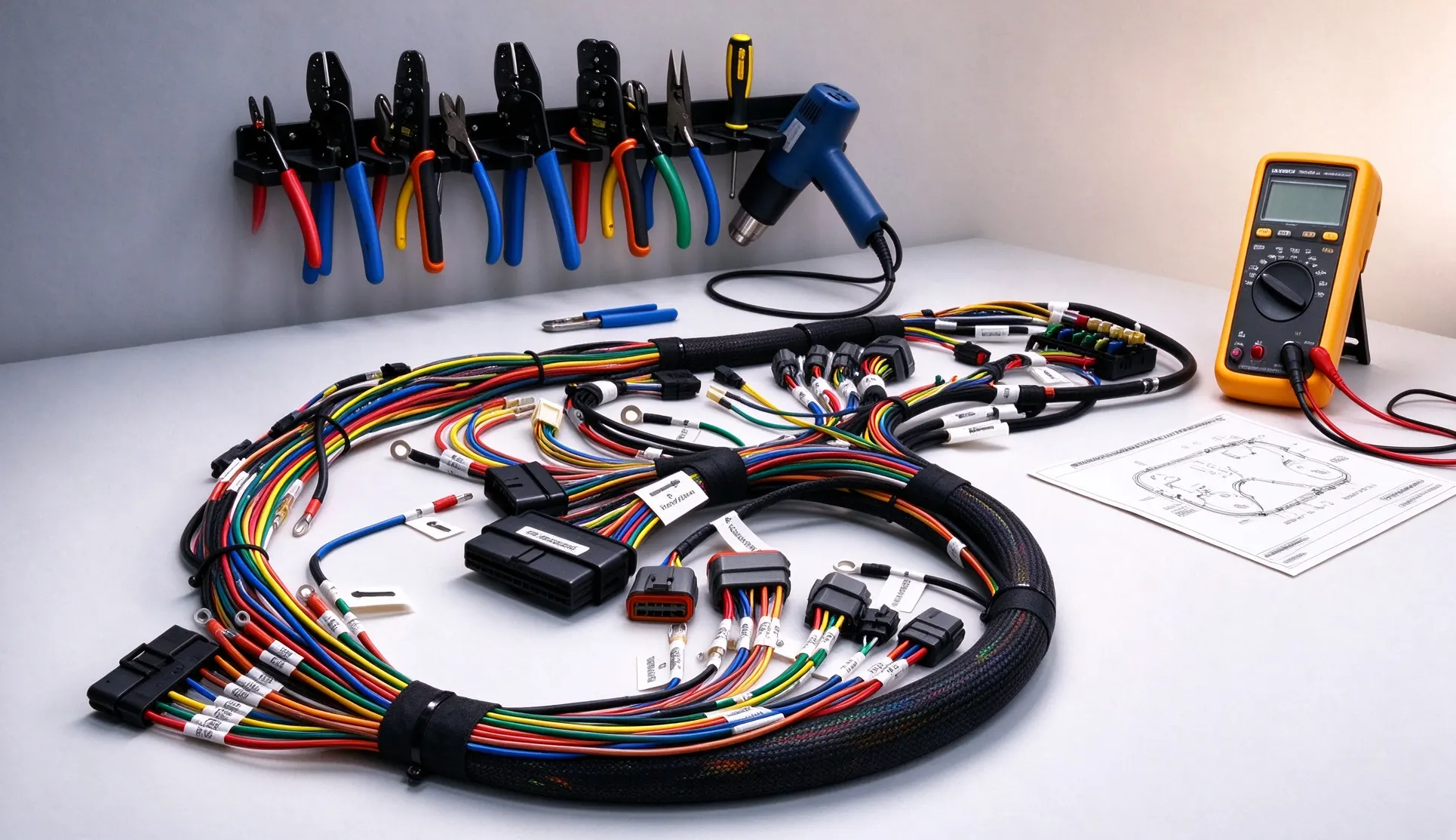
Explore medical device wiring.
Three areas cover most device builds: signal, power and the interface to the outside world.
Medical equipment projects arrive with an approved bill of materials and a validation plan. The harness is built against both, and the inspection records travel with the shipment.
Low-level circuits where noise pickup and stable contact resistance decide measurement quality.
Sensor and electrode leads
Low-noise leads with defined shielding and connector contact materials.
Board-to-board signal wiring
Compact assemblies routed inside the enclosure within the available space.
Shielded analogue paths
Where the signal level requires a defined shield reference and separation from power.
Regulatory approval, biocompatibility assessment and clinical validation stay with the equipment manufacturer. Harnk supplies assemblies and records to the approved specification.
What a medical harness quotation needs
The build is part of the scope; the records are the other part.
Approved BOM
Wire, connector, terminal and accessory part numbers with the applicable revision.
Drawing and routing
Harness drawing plus the routing constraints inside the enclosure.
Electrical requirements
Voltage, current, signal type, shielding and any isolation requirement.
Cleaning and environment
Cleaning agents, temperature range, humidity and the IP rating each interface must hold.
Inspection scope
Which tests run on every unit and which on a sample, plus the acceptance criteria.
Records
Lot marking, material certificates and the documents that must accompany each shipment.
Where the equipment manufacturer specifies a material, that specification governs — substitutions are only proposed after review. See the medical application page
Different requirements. Different checks.
The verification scope has to be agreed before the first build, because it changes the process rather than the drawing.
Low-level signal paths
Check shield termination, pair geometry, contact resistance and insulation resistance across the assembly.
Mains-adjacent wiring
Verify creepage and clearance against the design, wire rating, fusing and earth-bond continuity.
Cleanable external assemblies
Confirm jacket and overmould compatibility with the cleaning agents, and that the mated pair holds its IP rating.
Traceability
Confirm lot marking, material records and which inspection results must accompany each assembly.
How the build is controlled
The same process controls run on every build, whether it is a prototype run or a repeat order.
IQC incoming control
Dedicated IQC staff inspect incoming materials and retain inspection records.
In-process inspection
First-article confirmation, patrol inspection, and SPC process monitoring.
MES traceability
MES covers the entire process flow, so any anomaly is located and handled fast.
8D closed-loop response
Agreed response times and internal escalation paths — clear ownership, fast resolution.
- Locked process parameters
- Crimping, soldering, molding and waterproofing run on locked parameters with defined acceptance criteria.
- Outgoing control
- OQC inspection and mix-prevention packaging standards control outbound quality.
- Compliance documents
- Certifications and test reports available on demand for compliance audits.
- Factory visits
- Book a tour and walk the production floor along our visitor route.
Where to go next
Drone Wire Harnesses
Lightweight wiring for flight controllers, power distribution boards, gimbals, telemetry and payload modules — where every gram and every millimetre of routing matters.
ReadRobot Wiring Harnesses
Harnesses that follow the arm: controller links, dress packs, joint runs and end-effector wiring, where continuous motion decides the construction.
ReadIndustrial Machinery Wire Harnesses
Machine-internal and panel wiring built from the equipment drawing — the highest-volume custom harness category, and the one where documentation quality decides the result.
ReadHome Appliance Wire Harnesses
Internal wiring for household appliances, where the enclosure geometry, the thermal environment and the component approvals decide the assembly.
ReadCustom wire harness services
Configurations, customization options, assembly process and quality checks.
ReadAll applications
Wiring requirements by equipment type: industrial, automation, automotive and medical.
ReadQuestions that come up before ordering
01 What changes when the harness goes into a medical device? Process
The documentation and the material traceability, more than the assembly itself. Each conductor, sleeve and terminal is recorded, and any change to the drawing is versioned before it reaches the line.
02 Can fine-wire conductors be terminated reliably? Termination
Yes, with the correct terminal and crimp tool for the wire class. Fine stranding needs a smaller crimp nest, and the pull-test value is set for that combination rather than borrowed from a larger gauge.
03 Which jacket materials are available? Material
Silicone where flexibility and temperature range matter, TPU where abrasion resistance does. Material grade is confirmed against the device specification before the run.
04 What is supplied with each batch? Documentation
Material lots, crimp records and continuity results are retained against the batch, and the documentation package can be issued with the shipment on request.
Planning Medical Equipment Wire Harnesses?
Send the drawing, the connector schedule or a photo of the existing assembly. We review what you have and come back with the open points and a quotation path.