
Built to specification · Applications
Wire Harness & Cable Assembly Solutions for Industrial Equipment
Harnesses and cable assemblies for machine builders, panel shops and equipment manufacturers — built to the drawing, the connector schedule and the installation space inside the machine.
Panel + field
Scope
Multi-vendor
Interfaces
Drawing-led
Build basis
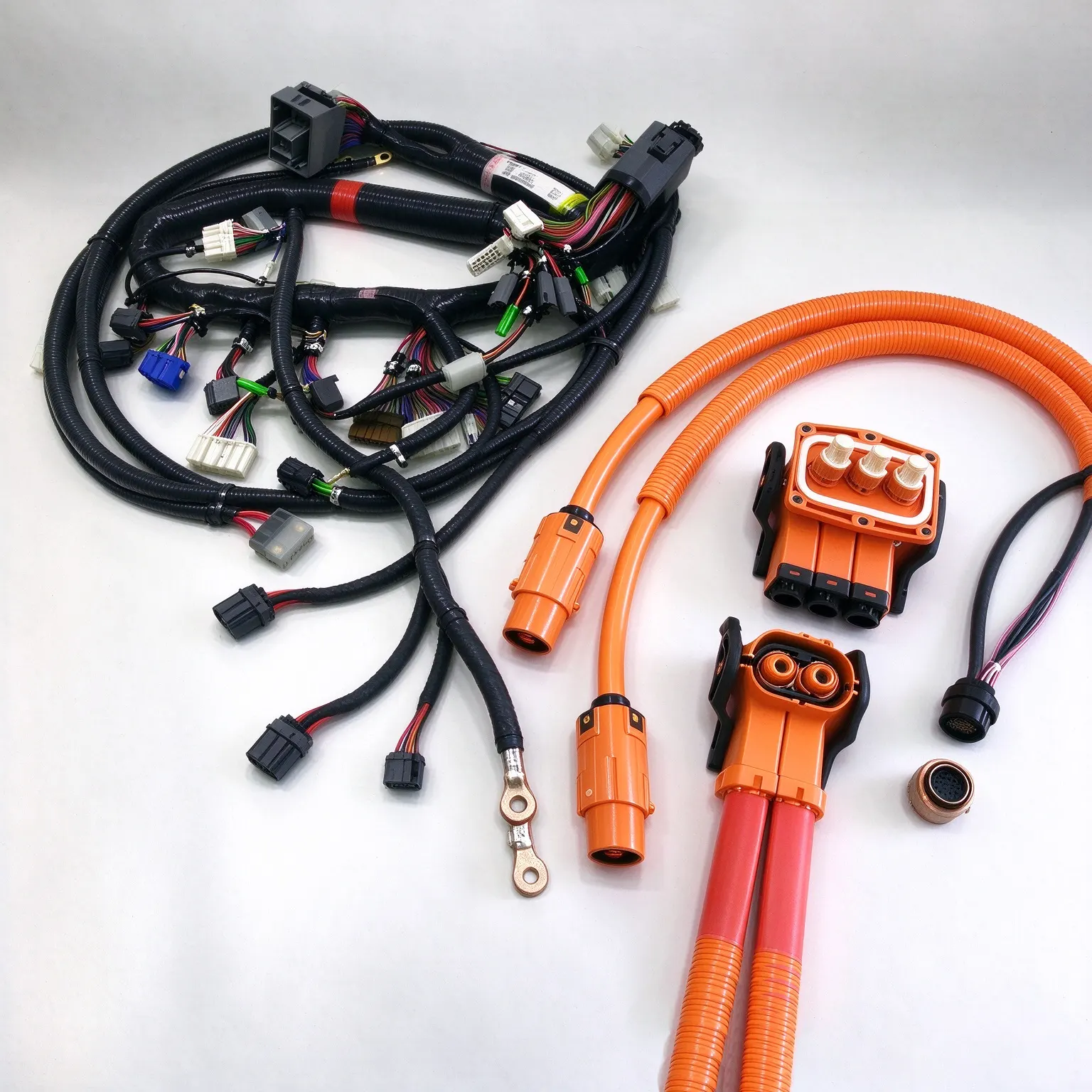
Explore wiring for industrial equipment.
Pick the part of the machine you are wiring. Each area has its own connector conventions, protection requirements and routing constraints.
Most industrial projects start from an existing BOM, a wiring diagram or a sample harness that needs to be reproduced or improved. Harnk reviews that input, confirms the open points and coordinates production against the approved specification.
Internal panel wiring and cabinet-to-cabinet connections, where wire identification and termination quality drive serviceability.
Panel wiring harnesses
Cut-to-length wiring with ferrules, ring terminals or connector housings, labelled per the customer wire list.
ReadCabinet-to-cabinet looms
Multi-core assemblies with strain relief, sleeving and connector keying for inter-panel runs.
ReadDIN-rail and terminal-block leads
Pre-terminated leads and jumper sets for terminal blocks, relays and interface modules.
ReadThese are starting points for a specification discussion, not a wiring standard. The machine directive, the panel design and the equipment manufacturer instructions determine the final arrangement.
Bring the machine details. Get a usable quotation.
Send the existing documentation or answer the points below. Where a value is not confirmed yet, flag it for review rather than letting it be assumed.
Drawing or wire list
Harness drawing, schematic or wire list with circuit functions and connection points.
Connector schedule
Manufacturer and part number for each connector and terminal, plus any approved alternatives.
Electrical duty
Operating voltage, current per circuit, signal type and any shielding or impedance requirement.
Mechanical limits
Lengths, branch positions, bend radius, routing path and available space at each connector.
Environment
Temperature range, fluid exposure, flexing duty, vibration and required IP rating.
Order profile
Prototype quantity, first production batch and expected annual volume, plus labelling and packaging rules.
Not sure which documents you can supply? Start with a photo of the existing harness and the connector part numbers — the open points can be closed during review. See what a harness quotation needs
Different equipment. Different checks.
A control cabinet and a washdown conveyor do not present the same wiring questions. Start from the environment and the duty cycle, then choose the conductor, jacket and connector.
Control cabinets and enclosures
Check wire identification, ferrule crimp quality, terminal torque, separation of power and signal, and the space left for service loops.
Motors, drives and motion axes
Check conductor sizing against the drive rating, shielding and earthing practice, bend radius at the moving end, and continuous-flex requirements.
Washdown and coolant-exposed areas
Confirm IP rating of the mated connector pair, jacket material compatibility with the fluid, gland sealing and cable routing away from pooling areas.
High-vibration machinery
Review fixing intervals, strain relief at the connector, crimp rather than solder where vibration is continuous, and abrasion protection at contact points.
Build the wiring scope
Most industrial projects combine two or three of the families below. Open a family to see construction options, or start from the harness page if the assembly is fully custom.
Wire harnesses — built to drawing
Multi-branch assemblies with customer-specified connectors, terminals, lengths and labelling.
Cable assemblies — standard families, built to order
Circular, data and power assemblies produced in the length, pinout and jacket the project needs.
How the build is controlled
The same process controls run on every build, whether it is a prototype run or a repeat order.
IQC incoming control
Dedicated IQC staff inspect incoming materials and retain inspection records.
In-process inspection
First-article confirmation, patrol inspection, and SPC process monitoring.
MES traceability
MES covers the entire process flow, so any anomaly is located and handled fast.
8D closed-loop response
Agreed response times and internal escalation paths — clear ownership, fast resolution.
- Locked process parameters
- Crimping, soldering, molding and waterproofing run on locked parameters with defined acceptance criteria.
- Outgoing control
- OQC inspection and mix-prevention packaging standards control outbound quality.
- Compliance documents
- Certifications and test reports available on demand for compliance audits.
- Factory visits
- Book a tour and walk the production floor along our visitor route.
Where to go next
Industrial Automation
Sensor cordsets, actuator leads, junction assemblies and fieldbus links for automation cells — supplied in the length, pinout and jacket the cell actually needs.
ReadAutomotive
Diagnostic cables, high-speed data links, sensor looms and lighting harnesses for vehicle programmes and aftermarket equipment — built to drawing, with the inspection scope agreed up front.
ReadMedical Equipment
Internal wiring and external cable assemblies for diagnostic, laboratory and patient-adjacent equipment, where documentation and repeatability matter as much as the electrical result.
ReadCable assemblies
Circular, data and power assemblies built to the length, pinout and jacket the project needs.
ReadCustom wire harnesses
Multi-branch harnesses built from customer drawings, BOMs or existing samples.
ReadQuestions that come up before ordering
01 Where does the harness scope usually start and stop? Scope
At the terminals the machine drawing defines: from the panel terminals out to the field devices, including the connectors at each end. Anything beyond that boundary is a separate sub-assembly.
02 How are third-party device connectors handled? Compatibility
The connector series is fixed to the device the machine uses, so the harness mates without an adaptor. Where a device changes, the affected branch is revised rather than the whole harness.
03 Can spare conductors be built in for later options? Design
Yes. Spare ways are common where a machine has option variants, and they are labelled and terminated at the panel end so the option can be added without a new harness.
04 What is supplied with each batch? Documentation
Continuity, pinout and label scheme are checked against the drawing, and the inspection record can be issued with the shipment on request.
Planning Industrial Equipment?
Share the drawing, the connector schedule or the existing sample. We review the available information and confirm the open points before quoting.