
Specified to your build · Terminals
Quick-Disconnect Terminals
The tab and receptacle family, where the joint is made by pushing rather than by tightening.
2.8 – 9.5 mm
Tab widths
22 – 10 AWG
Wire range
Friction / dimple
Retention
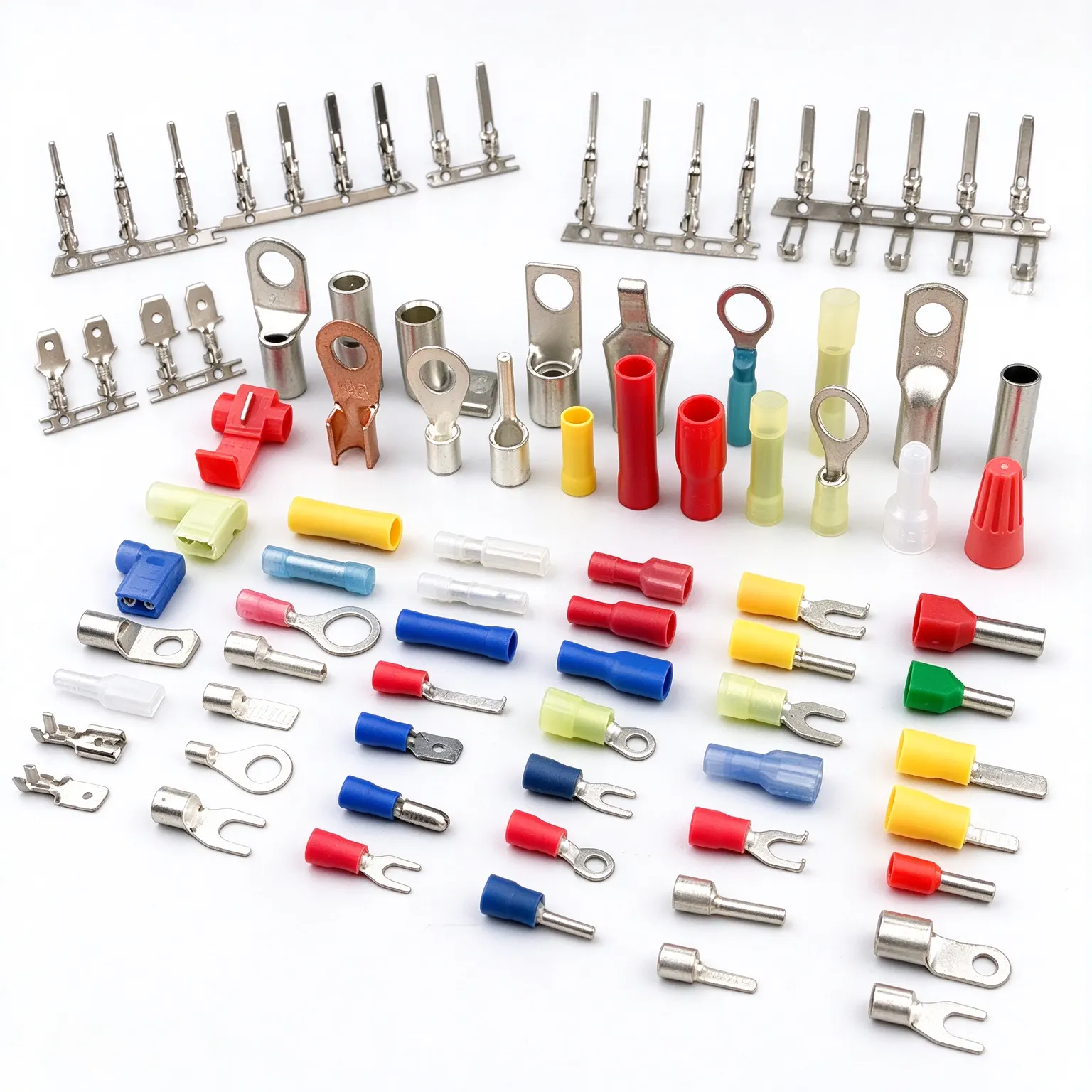
Range and variants
Tab width sets the current and the retention force, not the wire gauge. A 6.3 mm tab carries more than a 2.8 mm one on the same wire, and the receptacle has to be the same width as the tab or the joint heats at the contact.
Fully insulated
Touch-safe without sleeving, colour-coded by wire range.
Piggyback
A tab on the back of the receptacle, for stacking two circuits.
Flag versions
Right-angle entry where the wire has to leave sideways.
What has to be specified
The values that decide whether the part fits, before price or lead time are discussed.
- Tab width
- 2.8, 4.8 and 6.3 mm, plus 9.5 mm for higher current.
- Wire range
- 22 to 10 AWG.
- Insulation
- Bare, or fully insulated with a colour code.
- Retention
- Friction only, or with a locking dimple.
- Plating
- Electro-tin over brass.
How the build is controlled
The same process controls run on every build, whether it is a prototype run or a repeat order.
IQC incoming control
Dedicated IQC staff inspect incoming materials and retain inspection records.
In-process inspection
First-article confirmation, patrol inspection, and SPC process monitoring.
MES traceability
MES covers the entire process flow, so any anomaly is located and handled fast.
8D closed-loop response
Agreed response times and internal escalation paths — clear ownership, fast resolution.
- Locked process parameters
- Crimping, soldering, molding and waterproofing run on locked parameters with defined acceptance criteria.
- Outgoing control
- OQC inspection and mix-prevention packaging standards control outbound quality.
- Compliance documents
- Certifications and test reports available on demand for compliance audits.
- Factory visits
- Book a tour and walk the production floor along our visitor route.
Where this is used
Appliance and machine controls
Switches, relays and solenoids that present a tab terminal.
Vehicle wiring
Accessory and lighting circuits where the joint is pushed together on the line.
Serviceable field connections
Components replaced without a tool or a screwdriver.
Questions that come up before ordering
01 Does tab width or wire gauge set the current? Selection
Tab width. A 6.3 mm tab carries more than a 2.8 mm one on the same wire, and the receptacle has to match the tab width or the contact heats.
02 When do I need a locking dimple? Retention
Where the joint sees vibration. Friction alone holds on a static panel; a dimple or a locking receptacle is what keeps a vehicle connection seated.
03 What is a piggyback for? Application
It puts a second tab on the back of the receptacle, so two circuits can stack on one supply point without a separate splitter.
04 Fully insulated or bare? Selection
Fully insulated for touch safety and colour coding. Bare where the joint runs hot or where the housing provides the insulation.
Need quick-disconnect terminals specified to your build?
Send the drawing, the environment and the interface. We confirm the open points before quoting, so the part you receive is the part that was specified.
- Drawing review before quote
- Prototype to volume
- Certifications on request