
Built to specification · Wire Harnesses
Industrial Machinery Wire Harnesses
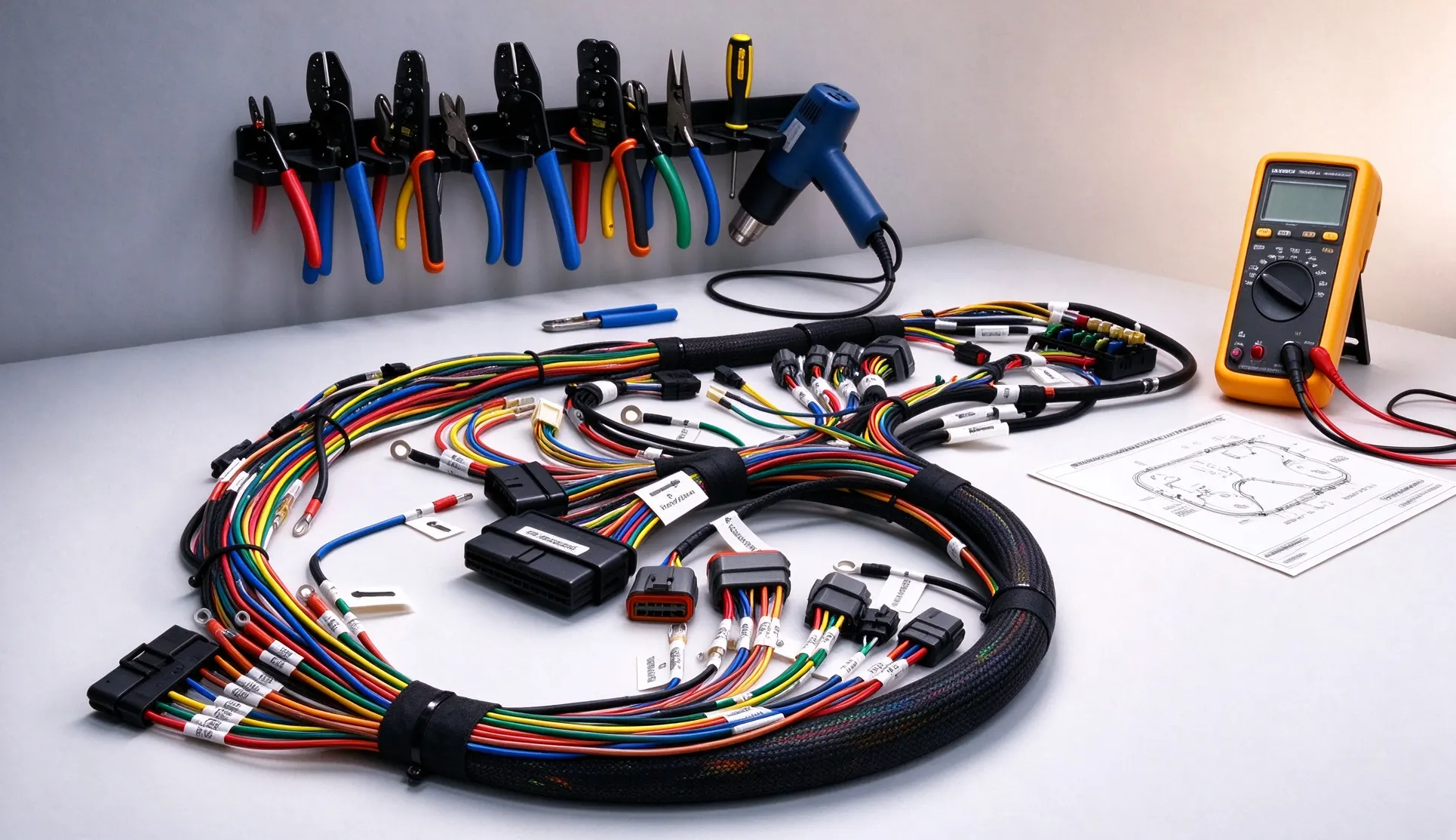
Machine-internal and panel wiring built from the equipment drawing — the highest-volume custom harness category, and the one where documentation quality decides the result.
Panel to field
Scope
Multi-branch
Construction
Label per drawing
Identification
Explore machinery harness areas.
Machine wiring splits by location: inside the cabinet, along the machine, and at the operator interface.
Machine builders usually have a wire list and a layout, but not always a harness drawing. Converting one into the other is part of the review, and it is where most specification errors get caught.
Dense wiring where identification and termination quality drive serviceability.
Panel wiring looms
Cut-to-length leads with ferrules or the terminals the panel design specifies, labelled per the wire list.
Interface and terminal-block leads
Pre-terminated leads and jumpers for terminal blocks, relays and interface modules.
Cabinet-to-cabinet links
Multi-core assemblies with strain relief and connector keying for inter-panel runs.
Machine safety, EMC and the applicable standards remain with the machine builder. Harnk builds to the supplied specification and inspection scope.
What a machinery harness quotation needs
Machine projects move fastest when the wire list and the layout arrive together. If only one exists, the review starts by reconciling them.
Wire list or schematic
Circuit functions, conductor sizes and the connection points for each wire.
Layout or routing
Where each harness runs and the length available at each branch.
Connector schedule
Manufacturer and part number for every connector and terminal.
Environment
Coolant, oil, chips, temperature and the IP rating each interface must hold.
Identification
Wire marking, sleeve labels and the numbering scheme the builder uses.
Inspection scope
Continuity, hipot, dimensional checks and which results must ship with the batch.
If the wire list exists but the harness drawing does not, that is a normal starting point — the drawing can be developed during review. See what a harness quotation needs
Different locations. Different checks.
A panel loom and a coolant-exposed machine run are not built the same way, even when the circuit is identical.
Inside the cabinet
Check wire identification, ferrule crimp, terminal torque and the separation of power and signal conductors.
Along the machine
Confirm jacket material against coolant and oil, abrasion protection at brackets, and IP rating at every connector.
Moving machine parts
Review bend radius, flex rating and the fixing intervals that stop the cable from taking load at the connector.
Operator areas
Check strain relief at the panel entry, handle and coil life for pendants, and protection where the run crosses an access point.
How the build is controlled
The same process controls run on every build, whether it is a prototype run or a repeat order.
IQC incoming control
Dedicated IQC staff inspect incoming materials and retain inspection records.
In-process inspection
First-article confirmation, patrol inspection, and SPC process monitoring.
MES traceability
MES covers the entire process flow, so any anomaly is located and handled fast.
8D closed-loop response
Agreed response times and internal escalation paths — clear ownership, fast resolution.
- Locked process parameters
- Crimping, soldering, molding and waterproofing run on locked parameters with defined acceptance criteria.
- Outgoing control
- OQC inspection and mix-prevention packaging standards control outbound quality.
- Compliance documents
- Certifications and test reports available on demand for compliance audits.
- Factory visits
- Book a tour and walk the production floor along our visitor route.
Where to go next
Drone Wire Harnesses
Lightweight wiring for flight controllers, power distribution boards, gimbals, telemetry and payload modules — where every gram and every millimetre of routing matters.
ReadRobot Wiring Harnesses
Harnesses that follow the arm: controller links, dress packs, joint runs and end-effector wiring, where continuous motion decides the construction.
ReadHome Appliance Wire Harnesses
Internal wiring for household appliances, where the enclosure geometry, the thermal environment and the component approvals decide the assembly.
ReadMotorcycle Wire Harnesses
Main looms and auxiliary assemblies for motorcycles and powersports vehicles, where vibration, water and heat from the engine define the construction.
ReadCustom wire harness services
Configurations, customization options, assembly process and quality checks.
ReadAll applications
Wiring requirements by equipment type: industrial, automation, automotive and medical.
ReadQuestions that come up before ordering
01 How are branch points and lengths defined? Design
From the machine drawing: each branch carries its own length, its own bundle size and its own endpoint. A harness built from a marked-up drawing installs without rework.
02 How are conductors identified? Identification
Wire marking, sleeve labels or printed markers per the drawing, applied at both ends of each conductor. The scheme is fixed before the run so service can trace a circuit later.
03 Can the harness be split into sub-assemblies for shipping? Logistics
Yes. Large harnesses are commonly built and tested in sections with keyed connectors at the joints, which also makes field replacement practical.
04 What is supplied with each batch? Documentation
Continuity, pinout, branch length and label scheme are checked against the drawing, and the inspection record can be issued with the shipment on request.
Planning Industrial Machinery Wire Harnesses?
Send the drawing, the connector schedule or a photo of the existing assembly. We review what you have and come back with the open points and a quotation path.