
Products
Connectors
Interfaces specified by manufacturer and part number, matched to the wire, the terminal and the environment they have to survive.
04
Catalogue groups
12
Ranges documented
To drawing
Non-standard builds
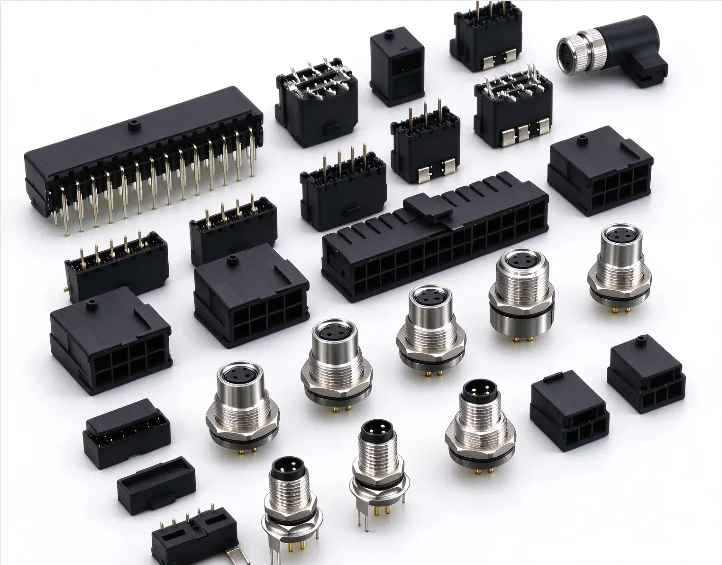
A connector is never chosen alone. The housing decides the terminal, the terminal decides the crimp tool, and the wire has to fit both. That is why connector selection is reviewed together with the assembly.
Circular
Sealed, threaded or push-pull interfaces for sensors, actuators and field connections.
Wire-to-wire and wire-to-board
The high-volume housings inside equipment, where pitch and retention decide the choice.
Wire-to-wire housings
Polarised housings with crimp contacts for inline connections and extensions.
ReadWire-to-board headers
Board headers in 1.0, 1.25, 1.5, 2.0, 2.5 and 2.54 mm pitch families.
ReadBoard-to-board and FPC/FFC
Fine-pitch connectors for internal board links and flex cable termination.
ReadSealed and automotive
Where ingress protection and vibration retention are part of the specification.
Terminals and contacts
The contact is half the connection — it has to match the housing and the wire.
What decides a connector choice
Five parameters settle most connector decisions. Where any of them is unknown, the selection is not finished.
Pitch and pole count
Set by the board or the device interface, not by preference.
Current per contact
Decides the contact size, which in turn constrains the wire gauge.
Sealing
IP rating of the mated pair, and whether the connector is inside or outside an enclosure.
Retention
Locking, CPA and TPA features where vibration or handling could work the connector loose.
Plating and temperature
Contact plating and housing material against the environment and the mating cycles expected.
Not sure which connector fits?
Send a photo of the housing or the board header with the pitch and pole count. We identify the family and confirm the matching terminal and wire range.