
Specified to your build · Connectors
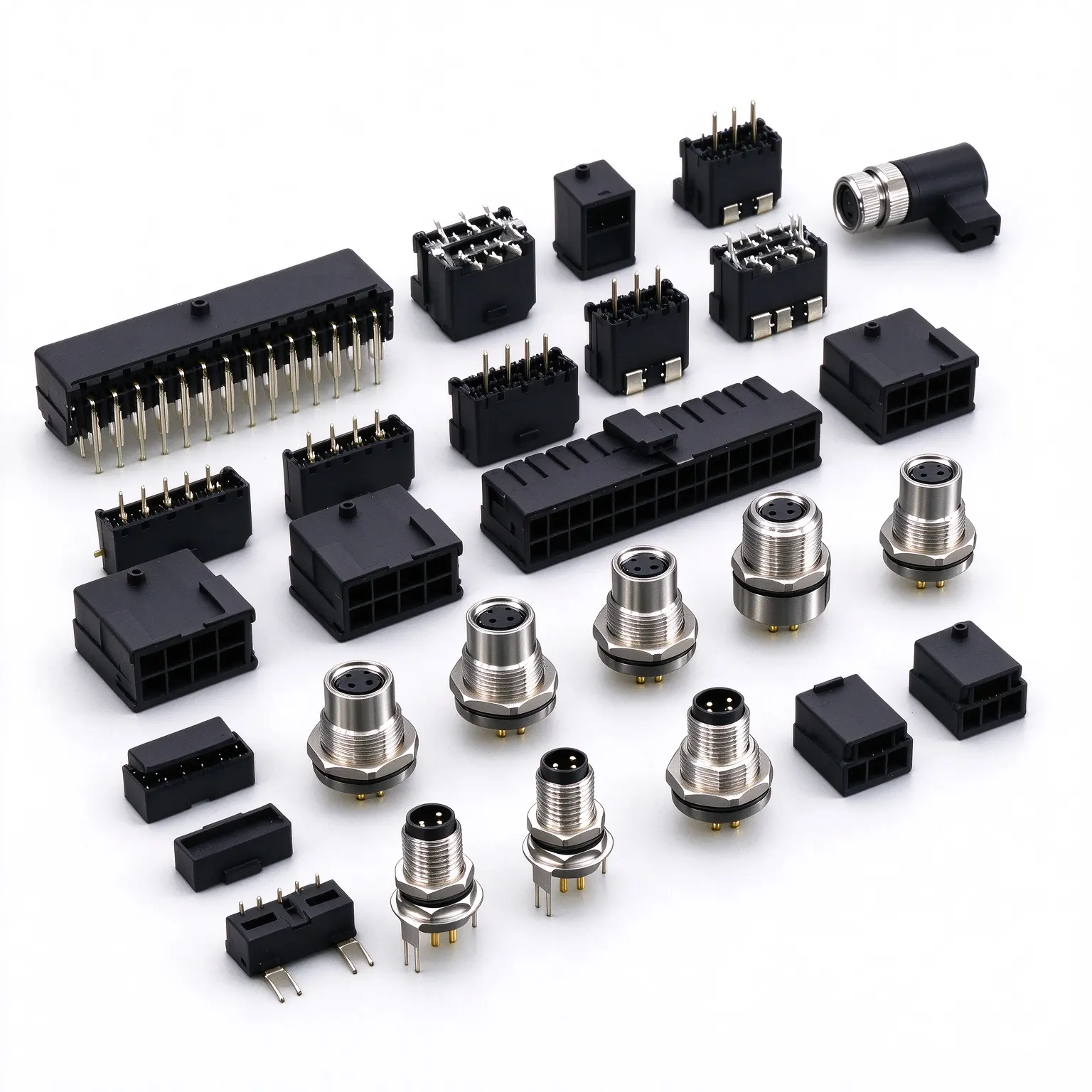
Circular Connectors
Threaded and push-pull circular interfaces, where the coupling is the seal and the coding prevents a wrong mate.
M8 / M12 / M16
Shell sizes
3 – 12
Contacts per interface
IP67 / IP68
Sealed when mated
Range and variants
M8, M12 and M16 cover most of the sensor and actuator market. What separates them is pole count, coding, and whether the coupling has to hold under vibration or washdown. The connector is usually the only sealing interface on the device, so the mated pair is specified as one part.
Overmoulded cordsets
Connector and cable moulded as one part, for fixed lengths and volume builds.
Field-assembly versions
Screw or push-in termination on site, where the length is not known in advance.
Panel-mount and bulkhead
Front or rear mounting with a defined thread length through the panel.
Overmoulded cordsets
- Length set at
- Build
- Seal responsibility
- Moulded joint, factory tested
- Re-termination
- Not possible
- Cable end
- Moulded to the connector
- Best for
- Volume builds, fixed routing
Field-assembly versions
- Length set at
- Site
- Seal responsibility
- Depends on termination
- Re-termination
- Screw or push-in on site
- Cable end
- Free conductor
- Best for
- Repair, unknown length
Panel-mount and bulkhead
- Length set at
- Build
- Seal responsibility
- O-ring against the panel
- Re-termination
- Not possible
- Cable end
- Free conductor or PCB pin
- Best for
- Enclosure wall, bulkhead
What has to be specified
The values that decide whether the part fits, before price or lead time are discussed.
- Contact count
- M8: 3, 4 and 5 pole. M12: 3 to 8 pole. M16: 2 to 12 pole.
- Coding
- A, B, D and X coding on M12; A coding on M8; keyed shells on M16.
- Sealing
- IP67 mated, IP68 on selected sealed versions.
- Coupling
- Threaded on M8 and M12, push-pull and bayonet options.
- Termination
- Screw, solder, crimp and IDC, depending on series.
How the build is controlled
The same process controls run on every build, whether it is a prototype run or a repeat order.
IQC incoming control
Dedicated IQC staff inspect incoming materials and retain inspection records.
In-process inspection
First-article confirmation, patrol inspection, and SPC process monitoring.
MES traceability
MES covers the entire process flow, so any anomaly is located and handled fast.
8D closed-loop response
Agreed response times and internal escalation paths — clear ownership, fast resolution.
- Locked process parameters
- Crimping, soldering, molding and waterproofing run on locked parameters with defined acceptance criteria.
- Outgoing control
- OQC inspection and mix-prevention packaging standards control outbound quality.
- Compliance documents
- Certifications and test reports available on demand for compliance audits.
- Factory visits
- Book a tour and walk the production floor along our visitor route.
Where this is used
Sensors and I/O devices
Compact M8 and M12 cordsets at the device end, where the connector carries the whole IP rating.
Actuators and valve terminals
Higher pole counts and more current per contact, usually M12 A-coded or M16.
Field wiring through an enclosure
Bulkhead and panel-mount versions that carry the interface through a wall without a separate gland.
Where to go next
Questions that come up before ordering
01 Can an M8 connector replace an M12? Coding
Only where the circuit fits the smaller contact count and current. M8 tops out at 5 poles with thinner contacts, so the swap changes the current rating, not just the footprint. The thread and the panel cut-out differ as well.
02 What actually carries the IP rating — the connector or the cable? Sealing
Both, as a mated pair. The interface seals against its mating half; the cable entry seals against the jacket diameter it was built for. A connector rated IP67 with the wrong jacket size is no longer IP67.
03 How do I tell A, B and D coding apart? Coding
By the keyway position on the insulator, not the housing colour. A coding has a straight keyway, B has an offset one, D uses a smaller keyway with four contacts. A wrong-coded pair will not mate, which is the point of the coding.
04 Do I need shielded contacts? Shielding
Only when the signal is fast enough or the environment noisy enough for the shield to matter — encoder lines, Ethernet, analogue sensors near drives. Shielded versions need the shield bonded at the coupling nut, otherwise it is a wire with no drain.
05 Can you build to a pinout I define? Custom
Yes. Send the pinout, the cable type and the length. The connector is specified against your drawing rather than picked from a fixed list.
06 Field-assembly or moulded cordsets? Assembly
Moulded for volume and fixed routing; field-assembly where the length is only known on site or where a repair has to happen without a spare. The trade-off is sealing consistency — a moulded joint is tested, a hand-made one depends on the operator.
Need circular connectors specified to your build?
Send the drawing, the environment and the interface. We confirm the open points before quoting, so the part you receive is the part that was specified.
- Drawing review before quote
- Prototype to volume
- Certifications on request