
Products
Cable assemblies built to the interface you already have
Fourteen families, all produced to order. The connector, the length and the jacket follow your drawing rather than a stock list.
04
Catalogue groups
14
Ranges documented
To drawing
Non-standard builds
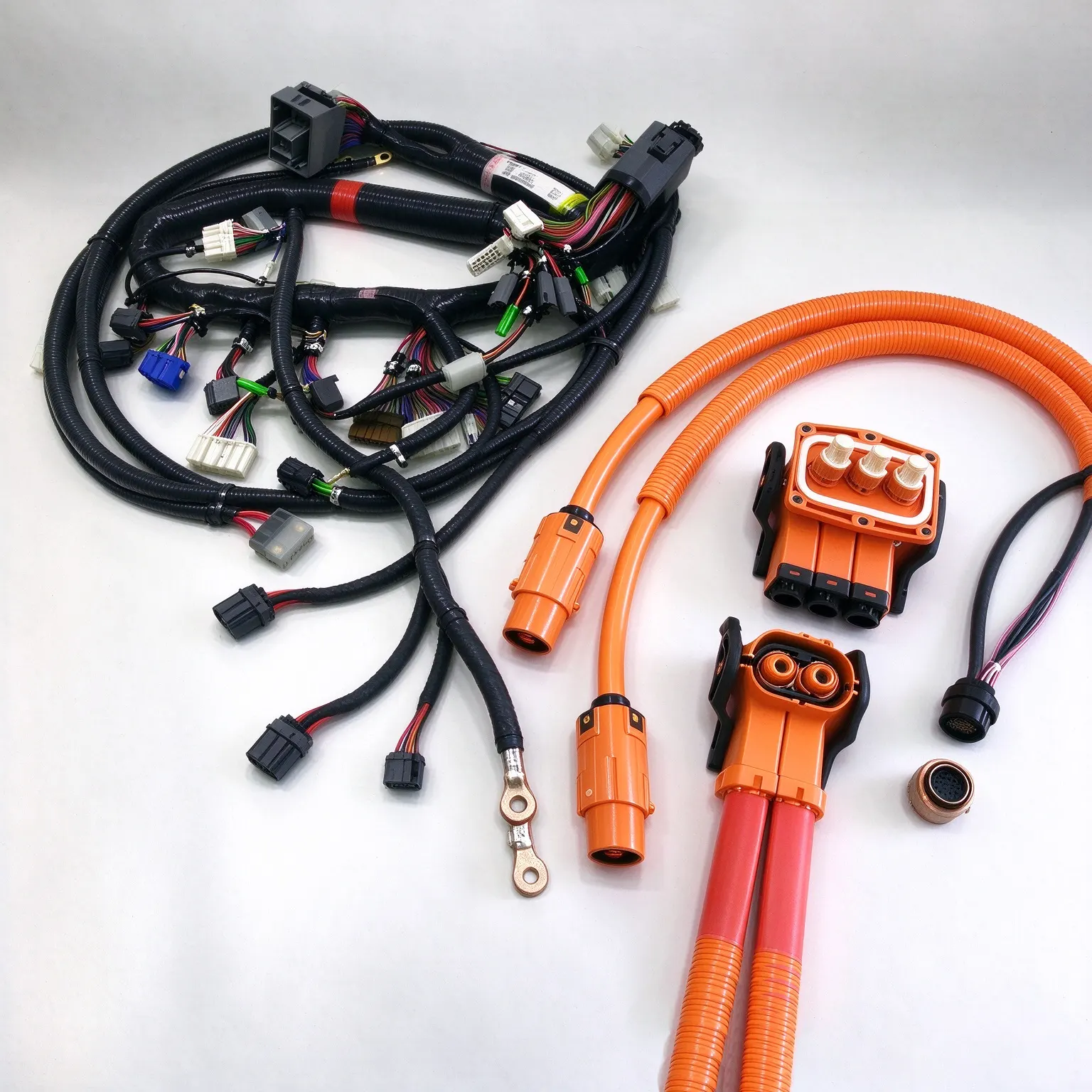
Every family page lists the parameters that have to be fixed before a build can be quoted — connector, length, jacket and termination — so the specification is settled before pricing starts.
Waterproof
Sealed circular assemblies for sensors, actuators and field connections. The IP rating applies to the correctly mated pair.
M8 Cables
Compact circular cordsets for proximity switches, photoelectric sensors and small I/O devices — where the connector is smaller than the cable gland it replaces.
ReadM12 Cables
The workhorse circular connector of industrial automation — sensors, actuators, junction blocks, fieldbus and Ethernet all pass through an M12 interface.
ReadM16 Cables
A larger circular interface for runs that carry more contacts or more current than an M8 or M12 body allows, while keeping a sealed screw-locked connection.
ReadElectronic
Data and signal assemblies where impedance, shielding or connector geometry carries the requirement.
OBD Diagnostic Cables
J1962 16-pin assemblies for scan tools, telematics devices, test benches and programming adapters — where pinout accuracy decides whether the tool connects at all.
ReadUSB Cables
USB links built into equipment rather than sold as accessories — where retention, bend life and panel mounting matter more than the retail finish.
ReadLVDS Cables
Controlled-impedance differential links between a display or camera module and its processing board, where the termination decides whether the image is stable.
ReadRibbon Cables
Flat cable assemblies for internal board-to-board links, where a low profile and a repeatable mass-terminated connection matter more than ruggedness.
ReadHSD Cables
Shielded differential assemblies for camera, display and infotainment links in vehicles and machines, built around the HSD connector system.
ReadSATA Cables
Internal storage links for equipment, industrial PCs and test systems — where the connector latch and the bend radius decide whether the drive stays connected.
ReadIEEE 1394 Cables
FireWire links for machine vision cameras and legacy equipment, where the installed base still runs on 1394 and replacement assemblies have to match it exactly.
ReadIndustrial & Communication
Network, serial and coaxial links for equipment communication and instrumentation.
Ethernet Cables
Network links built for the factory floor rather than the office — where the jacket, the connector coding and the bend radius decide whether the link stays up.
ReadRS232 Cables
Serial links for instruments, scales, controllers and legacy equipment — where the wiring is either straight-through or null-modem, and getting it wrong means no communication.
ReadBNC Cables
Coaxial links for test equipment, video, sensors and instrumentation — where the impedance and the connector termination decide the signal, not the conductor alone.
ReadPower
Low-voltage power leads and distribution assemblies, sized against the load and the run length.
What decides an assembly build
Four parameters carry almost every decision on a made-to-order assembly. Fixing them in order keeps the quotation comparable between suppliers.
Interface
The connector on each end decides the housing, the contact system and the tooling before anything else is fixed.
Length and routing
Nominal length, the tolerance the installation allows, and how the assembly is supported along the run.
Jacket and protection
PVC, PUR or silicone, plus sleeving or shielding where the environment requires it.
Termination and test
Crimp, solder or IDC, with continuity and pinout checked against the drawing before packing.
Where to go next
Custom wire harnesses
Multi-branch harnesses, mixed connector types and assemblies with several breakouts — built from the drawing rather than a family template.
ReadConnectors
Interfaces specified by manufacturer and part number, matched to the wire, the terminal and the environment they have to survive.
ReadWires & cables
Conductors and jackets specified by gauge, temperature class and environment — the layer that decides most of an assembly’s service life.
ReadTerminals
The termination is where most wiring faults begin — a terminal that does not match the conductor, or a crimp that does not match the terminal.
ReadCable accessories
The components that decide whether an assembly survives its installation — protection, sealing, fixing and identification.
ReadSend the interface and the length
Connector part numbers, nominal length and the installation conditions are enough to start. We confirm the open points before quoting.