
Reference tools and selection guides
The calculators and guides we use when reviewing a harness or cable assembly specification — published so the first draft of a drawing can be a good one.
Engineering calculators
Five tools covering the checks that come up before a drawing is issued: conductor sizing, voltage drop, ampacity, unit conversion and cost estimation.
Wire Gauge Calculator
Recommend a wire gauge from load current, cable length, and the allowed voltage drop.
Open toolVoltage Drop Calculator
Calculate the voltage drop of a copper or aluminum run from gauge, current, and length.
Open toolAWG Converter
Convert between AWG sizes and metric cross-sections, with a full reference table.
Open toolCurrent Capacity Calculator
Look up the ampacity of copper conductors by AWG size and insulation temperature rating.
Open toolWire Harness Cost Estimator
Estimate a harness cost by summing wire, connectors, terminations, materials, and labor inputs.
Open toolAll calculators
Open the calculator index for the full list and reference tables.
Selection guides
Articles on the decisions that come up repeatedly: identifying a connector, choosing a gauge, reading a pitch, and wiring a specific vehicle or device.

Automotive Wiring Harness: A Complete Guide from Basics to Practice
What an automotive wiring harness is, how to choose conductors, terminals, housings and shielding, plus installation practice and the fault-finding checks that catch most failures.

FPC Connector Selection Guide: Types, Specs and Reliability
ZIF, LIF and flip-lock FPC connectors, the four specs that actually decide the part, and how to match a connector to a display, camera or automotive application.

OBD Wiring Harness: From OBD to OBD2, ECU and CAN Bus
What an OBD wiring harness actually carries, how OBD2 standardised vehicle diagnostics, and why 'the scanner won't connect' is usually a physical-layer problem.

How to Identify an Electrical Connector
A structured way to identify an unknown connector from its pitch, pin count, mounting style, and keying features.
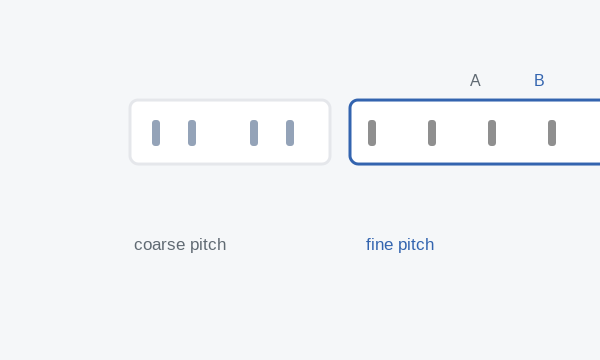
Connector Pitch vs. Pin Spacing
The difference between connector pitch and pin spacing — and how mixing up the two leads to ordering the wrong part.
How to Choose the Right Wire Gauge
Current, voltage drop, insulation, and flexibility: the factors that decide wire gauge, and how to balance them.
Have a specification to check?
Send the drawing or the BOM and we will review it against the calculators above — conductor sizing, drop, ampacity and the connector match.